From our Lecture today there is a quote
From: Looking at War: Photography’s View of Devastation and Death.
New Yorker Magazine Dec 9th 2002
‘ the problem of our reliance on images and especially photographic images is not that “people remember through photographs but that they remember only the photographs … that the photographic image eclipses other forms of understanding—and remembering. … To remember is, more and more, not to recall a story but to be able to call up a picture” ‘.
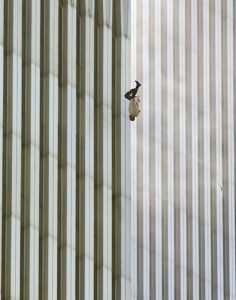
I disagree. To me this is a photographic image that I understand, remember, and most definitely recall the story, of ‘The Falling Man’.
The Falling Man is a documentary about a picture taken at the Twin Towers in New York on September 11th 2001 when they were hit by two aircraft in a terrorist attack.
I distinctly remember that image, a man falling to his death from the burning building. They ran it in the Daily Mail, my mum’s choice of newspaper at the time.
I remember seeing the images of the twin towers and feeling as though I had turned on the tv in the middle of a disaster movie. It was completely surreal.
It wasn’t a movie, we were watching people dying in real time and I think it must be the most disturbing, horrifying, and gripping image of reality I have ever seen.
The documentary ‘The Falling Man’ sought to explain how a photographer who happened to be at that place and time, did his job and took images of the disaster as it unfolded and how as quickly as the image appeared, it disappeared. The question then became whether it should have been produced and projected around the globe at all. The photographer Richard Drew describes how, as he stood there, “people started coming down from the World Trade Center. Bodies were falling, so I instinctively picked up my camera and started taking pictures. It’s what I do. A carpenter has a hammer, builds houses, I have a camera, I take pictures”.
‘The Morning Call’ newspaper in Allentown debated in an office meeting which image to use. The Editor describes his reaction as a similar one to the Eddie Adams photograph of a prisoner being shot in the head by a South Vietnamese Police Chief. Another very disturbing and uncomfortable photograph of the last moments of a person’s life, but even so it received a Pulitzer prize. That may be one reason why they ran it but I don’t consider it the main one. The paper received the most response to this photograph than any other before.
Both photographer Drew and the writer Tom Junod, who followed up the story, felt that Americans needed to know that the people in the building had had to make choices, knowing they were going to die. Was it to be in the burning building consumed by flames, choked by the toxic fumes, or the only other escape falling to their death? There are of course a lot of details, discovered afterwards, about how the impact of the planes affected the structure of the buildings, the release of jet fuel and the inferno it caused making it almost impossible for anyone to escape. We know people were trapped. Juno asked at the coroner’s office how many people jumped and was told ‘none, there were no jumpers’. It seemed that America was unable to accept that people had made that choice. In the days that followed the press pushed out positive images of the heroes of the day, the rescue workers, fire-fighters, emergency workers and alike.
A Canadian writer Peter Cheyney was asked to try and discover who the ‘falling Man’ was and after a long investigation it was thought to be Numberto Hernandez. This turned out to be incorrect.
The unfinished story of the man still bothered Junod and he continued with his search, feeling that the man along with others who had fallen from the building had been unfairly erased from the lasting images.
After extensive research and talking to staff from ‘The Windows of the World’ Restaurant from which he felt the man came they agreed to look at the series of images to carefully attempt a deduction. It was the restaurant Chef Michael Lomanaco who methodically went through his missing staff and then very reluctantly looked through the series of images of falling man coming to the realisation that it could be Jonathan Briley a sound engineer who worked in the restaurant. Briley’s father The Reverend Briley could not look at the image, in spite of his great faith and suggested speaking to Jonathan’s sister.
The family had Jonathan’s identity confirmed by the coroner through DNA and dental records after reporting him missing. His sister Gwendolyn said “I never thought of the falling man as Jonathan. But I thought of him as a man that just took his life in his hand for just that second, did that person have so much faith that he knew God would catch him or was he so afraid to experience the end up there? That’s something I’ll never know because that happened to him.”
Having reached out as far as he could to identify the falling man Junod realised we could never be sure who he was and came to question did the man’s identity really matter? In fact he goes further and compares the falling man to have the same symbolism as The Tomb of the Unknown Soldier from other wars. That one unknown soldier, or in this case falling man represents so many others who were lost. The falling man forced the world to remember.
Junod believes of the image ‘looking at the falling man and to discuss it is the only option we have, given that there is a falling man’.
 https://learningonscreen.ac.uk/ondemand/index.php/prog/16DC01D9?bcast=137438875#
This is an excellent reflection Alison, well written and with good amount of important detail. Well done.