Today’s lecture was given by visiting speaker Professor Matt Johnston. How can we deliver our published work to the maximum effect?
Professor Johnston has worked with a numerous artists and publishers during his career and brought along a selection of contemporary photobooks for us to peruse.
In his lecture he described how the original book layouts were considered through a process of discussion with himself the artist and publisher. Through this process there is a combination of the manipulation of the images, consideration of size, placement, text [more, less, none], paper quality and image finish which will hopefully when complete will have evolved into a more receptive and engaging visual encounter for the reader.
The Photobook.
Having observed a number of them now I think we can safely assume that one of my picks is going to be a Martin Parr photobook! I’m not even going to apologise for diving back into ‘The Last Resort’ I love this book. For me, more than anything its about young families in the 1980s around the time when I had a young family of my own.
There are no words with the layout, just a plain page opposite with the page number. The images themselves are colourful and jam packed with so much detail that just draws your eye into it and each time I look at them I see something new. I feel as though the sequence shows possibly different areas of the resort from ‘entertainment’, to waterfront, lido, food and beach, and each image is within a white frame.
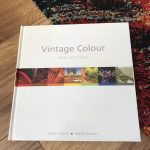
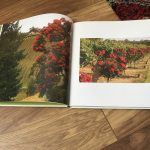
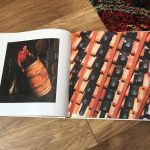
I did, for contrast, delve into another book, picked up at the local charity shop. ‘Vintage Colour’ by Photographer Steven Morris is a feast of colour based on his photographs of Australia’s Wineries.
‘Struck by the incredible southern light and the way it rendered colours with a unique brilliance’ when asked to produce a book of his Australian tour, Morris took inspiration from the simple colour wheel and laid it out with images from Red turning to brown, orange, yellow, green and blue.
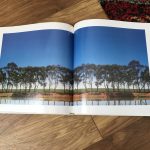
The effect is delightful, there is a short introduction and the layout then varies throughout from full page with and without white border, no border, four grid images, double page and page and a half images.
I personally would be happy to have both these books on my bookshelf.
The Last Resort focuses the reader by keeping the layout streamlined, a bold colourful image, enclosed in a white frame, it directs you immediately to the detail in the shot.
Parr is well known and his books sell. http://www.martinparr.com
Vintage Colour I would think covered a smaller market, although Morris has a well followed presence from my research. http://www.stevenmorris.com
Morris has a different layout as I have described above. Did the layout increase it’s appeal? I think it was a clever move to use the colours. It ties in with the subject [wineries] and country of origin [Australia], so I think it worked and I’m sure every winery he visited was pleased to receive a copy.
I feel that Professor Johnston’s theories on amplification and activation are over complicated and not part of the thought process of many artists when compiling a photobook. For instance while the strategy of using the colour wheel in ‘Vintage Colour’ may well be an example of amplification or activation, I’m not convinced that either were considered by the photographer. Similarly other design decisions will probably have been made according to the artists aesthetic rather than adhering to an academic design formula.
Is a simpler view that it’s really more about marketing? An approach in order to reach as wider audience as possible with, initially a photobook, but also other exhibits that our work may be involved with? If I am ever fortunate enough to get to the point where I need further advice on those strategies, [outside of University] I will now have a better idea of what to consider.